How to Make UGC Ads Without Actors Using AI in 2026
Hiring actors for UGC ads is slow and expensive. Here's how ecommerce brands are making scroll-stopping UGC ads without actors — entirely with AI.
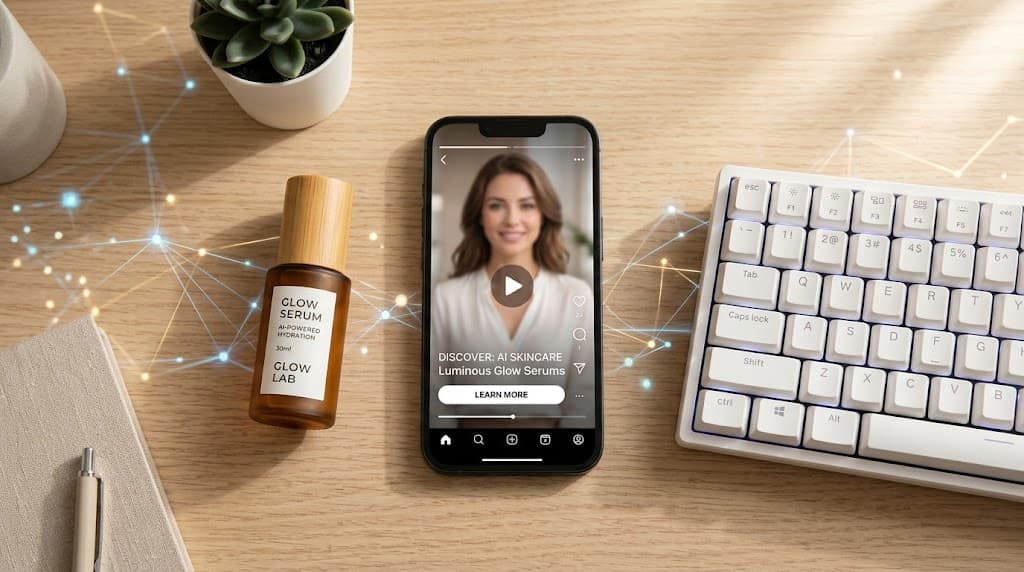
The Real Cost of Casting Actors for UGC Ads
If you've ever tried to scale UGC ads for an ecommerce brand, you already know the bottleneck: finding real people who look authentic on camera, who will deliver your script convincingly, and who won't ghost you three days before your campaign launch. The good news is that in 2025, you don't need any of that. Knowing how to make UGC ads without actors is now a genuine, production-ready skill — and brands doing it are cutting content costs by 70% or more.
The old UGC playbook meant reaching out to micro-influencers, negotiating rates, shipping product samples, chasing revisions, and hoping the final clip didn't feel stiff. Even with a solid creator network, a single UGC video could take two to three weeks and cost anywhere from $150 to $800 per deliverable. For performance marketers who need 20 ad variations a week to feed a testing machine, that model simply doesn't scale.
AI has changed the equation entirely. Today you can generate a realistic AI actor delivering a product testimonial, add a professional voiceover, layer in background music, and export a polished 30-second vertical video — all without booking a single human on camera. Here's exactly how to do it.
The AI Models Powering Actor-Free UGC Ads
The key to making believable actor-free UGC content is choosing the right AI models for each layer of the production. You don't need to be technical — you just need to understand what each model is good at and what it costs to run.
For the video itself, the best options in 2025 are:
- Kling 3.0 — Produces cinematic, highly natural human motion with strong facial consistency. At 160 credits ($3.20) per clip, it's the go-to for UGC-style testimonial footage that needs to feel personal and unpolished in the right way.
- Veo 3 Fast — Google's model excels at lifestyle and product-in-use scenarios. It generates a clip for just 60 credits ($1.20), making it ideal for high-volume ad testing where you need 15 variations quickly.
- Sora 2 Pro — When you need cinematic quality for a hero ad or a brand film, Sora 2 Pro delivers at 330 credits ($6.60). Overkill for split-testing, but worth it for a flagship creative.
For voice, ElevenLabs TTS is the clear standard — delivering natural-sounding voiceovers at just 5 credits ($0.10) per clip. You can clone a brand voice, switch accents, and adjust pacing without re-recording anything. For background music that fits the vibe without paying licensing fees, Suno v4.5 generates original tracks at 30 credits ($0.60).
For product imagery used in the ad — packshots, lifestyle frames, overlays — Imagen4 produces photorealistic results at 8 credits ($0.16) per image. Together, a complete UGC-style ad can cost well under $10 in AI generation costs.
Step-by-Step: Building a UGC Ad Without Any Actors
Here's a concrete production workflow any ecommerce brand or agency can follow. This assumes you're working in a canvas-based tool that connects your AI nodes together — more on that shortly.
Step 1 — Write your script first. UGC ads live or die by the hook. Keep it to 30–45 seconds of spoken content. Use a conversational, first-person tone: "I tried this for two weeks and honestly wasn't expecting much…" The script drives everything else, so don't skip this step.
Step 2 — Generate your AI actor video. Feed a visual prompt into Kling 3.0 or Veo 3 Fast describing the person, setting, and action. Be specific: "A woman in her late 20s, natural lighting, holding a skincare bottle, speaking candidly to a phone camera in a bathroom." Vague prompts produce vague results. Run 3–4 variations and pick the strongest.
Step 3 — Record the voiceover separately. Use ElevenLabs TTS to generate the spoken script in the voice style that matches your target customer. Sync it to your video clip in post.
Step 4 — Add product visuals. Generate clean packshots or lifestyle images with Imagen4 to overlay as B-roll or end-card frames. This is where the ad starts looking polished.
Step 5 — Layer in music. Prompt Suno v4.5 with a mood and genre — "upbeat, lo-fi, millennial nostalgia" — and generate a 30-second track. Drop it under the voiceover at low volume.
Step 6 — Export and test. Format for vertical (9:16) and square (1:1). Send both to Meta Ads Manager and let the algorithm pick its favourite. Repeat the process weekly with new hooks and visuals.
How LooksCraft Solves This on a Single Canvas
The biggest friction in the workflow above isn't the AI models — it's the constant tab-switching. Most teams are running Kling in one browser tab, ElevenLabs in another, Suno in a third, and trying to stitch everything together in CapCut. That's five tools, five logins, and five points of failure every time you need a new ad.
LooksCraft's Flow Studio puts the entire production on one infinite canvas. You add a Video Generation node (choose Kling 3.0, Veo 3 Fast, or any of our 46 video models), wire it to an Audio node powered by ElevenLabs, connect a Music Generation node running Suno v4.5, feed product images through an Imagen4 Image Generation node, and pipe everything into the Composer and Video Editor nodes — all without leaving the page. Hit Run All and the entire pipeline executes in sequence.
Pricing is straightforward: $0.02 per credit, no subscription, credits never expire. A complete actor-free UGC ad — video, voiceover, music, product image — typically runs between 200 and 260 credits ($4–$5.20 total). If you're producing 20 ads a month, that's under $110 in generation costs.
You can start building flows for free at lookscraft.com — credits are only needed when you hit Run. Try the UGC Ads template to see the full canvas pre-wired and ready to go.
Final Thoughts: The Actor-Free Ad Stack Is Here
The question used to be whether AI-generated UGC could be good enough. In 2025, that debate is settled. With models like Kling 3.0, Veo 3 Fast, and ElevenLabs handling video and voice, the output is genuinely convincing — and the cost and speed advantages are so significant that brands still waiting for "perfect" AI are already being outpaced by competitors running 50 variations a month at $5 a pop.
The next frontier isn't quality — it's workflow. Generating video in one tool, voice in another, music in a third, and editing in a fourth is still the norm for most teams, and it's brutally slow. The real unlock is a connected canvas where every generation step feeds directly into the next, and the whole pipeline runs with a single click. That's exactly what LooksCraft was built to do.
Whether you're running a Shopify brand testing new creative hooks, an agency managing UGC production for 10 clients, or a solo creator building your own ad business, the actor-free workflow is ready for you today. Sign up free at lookscraft.com, open the UGC Ads template, and run your first AI-generated ad in under an hour — no actors, no studio, no waiting.